System Configuration
1 min
Once you have a Tetherfi Secure Work from Home environment and admin login credentials, you can go through the following steps to configure and start using the product:
- Setup your Organizational Structure
- Configure initial Roles for your supervisors and agents
- Define your initial Remote Security Rules
- Enable features you want for different parts of your organization using Features
- Use the appropriate Installation to install Secure Work from Home on your agent desktops (and in your VDI environment if appropriate)
Big Picture
The following diagram shows the 5 core components of Secure Work from Home configuration and their relationships to each other. These components are introduced below the diagram, and detailed instructions for configuring these are available in later subsections.
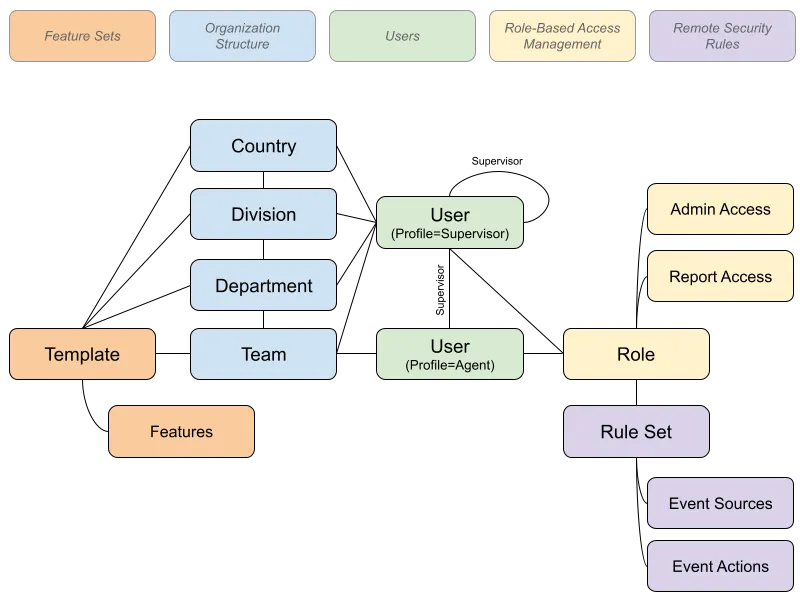
- Feature Sets - Different divisions, departments, or teams can have different sets of features turned on or off (e.g. this department does continual background face authentication, while this other team has watermarks configured). For more information, see Features
- Organizational Structure - Tetherfi supports 4 levels of organizational structure for the purposes of defining who can see, do, and administer what. For more information, see Organizational Structure
- Users - Secure Work from Home has 3 primary user profiles - administrators, supervisors, and users (or agents). Agents can only be associated with a team in the organizational structure. For more information, see User Management
- Role-Based Access Control - Roles are used to control what administration capabilities (if any) and/or reporting capabilities (if any) a user has. For more information, see Roles
- Remote Security Rules - Secure Work from Home allows highly configurable control over what should happen when certain events occur (e.g. when face authentication fails), and these Rules can be different for different user roles. For more information, see Remote Security Rules